
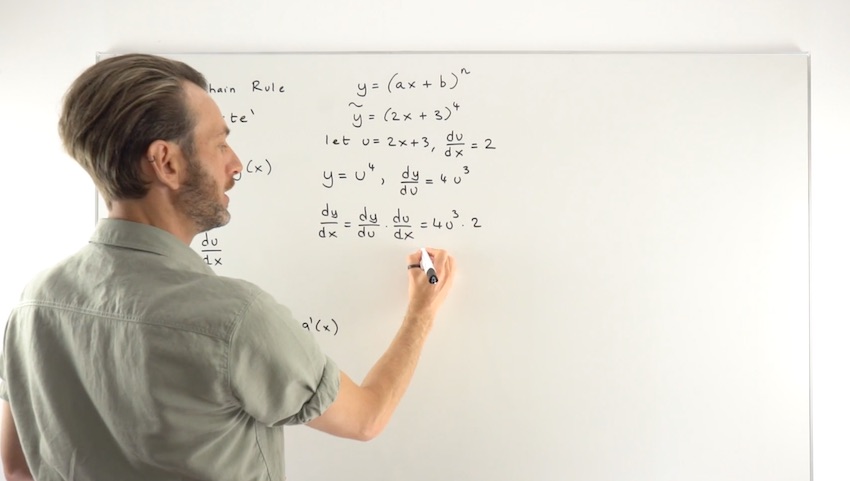
Learn how to differentiate Composite Functions using the Chain Rule
The differentiation chain rule is one of the primary techniques used to differentiate functions. It’s used to differentiate composite functions, although they may not always seem like composite functions. The differentiation chain rule allows us to differentiate a far wider set of functions that the power rule alone. In this video you’ll learn when and how to use the rule. But also check out The Chain Rule Examples to see the types of functions the chain rule can be applied to. Any questions about this video drop us a message HERE.
Key Points
The Chain Rule is for differentiating composite functions only
Composite functions can appear in many ways so try to learn some common forms
The Chain Rule essentially says to differentiate twice – once for the inner and once for the outer function
These two differentiation results are then multiplied together
The ‘rules’ for differentiating Trigonometric functions is actually a specific use of the Chain Rule
A bracket with a power on it is another common function type for using the Chain Rule
Learn more about our CALCULUS 1 course here